CRO / DTC
How Improving Conversion Rate Reduces CAC
// same spend, more customers, lower cost each

By Fracto Solutions
August 4, 2026
The short answer
Improving conversion rate reduces CAC because effective CAC is ad spend divided by customers acquired. At fixed spend, more conversions means more customers, so the cost of each one falls in proportion. A 50% lift in conversion cuts CAC by about a third; doubling it halves CAC.
This is the clearest cause-and-effect in ecommerce economics, and once you see the math, you cannot unsee it.
For the broader strategy of using CRO against rising ad costs, see the pillar guide. This piece is the mechanism, worked all the way through.
Why does a higher conversion rate lower CAC?
Because CAC is a fraction, and conversion rate controls the denominator. More conversions from the same spend means a lower cost per customer.
Effective CAC on a paid channel is, roughly, the money you spend divided by the customers that money produces. Your ad budget buys a certain number of visitors; your conversion rate decides how many become customers. Spend stays the same, but if more convert, you have acquired more customers for that fixed cost, so each costs less. You simply kept more of what you had already paid for.
What is the exact math?
At constant ad spend, CAC moves in inverse proportion to conversion rate. Double the conversion rate and you halve the CAC.
- CAC falls as conversion rises
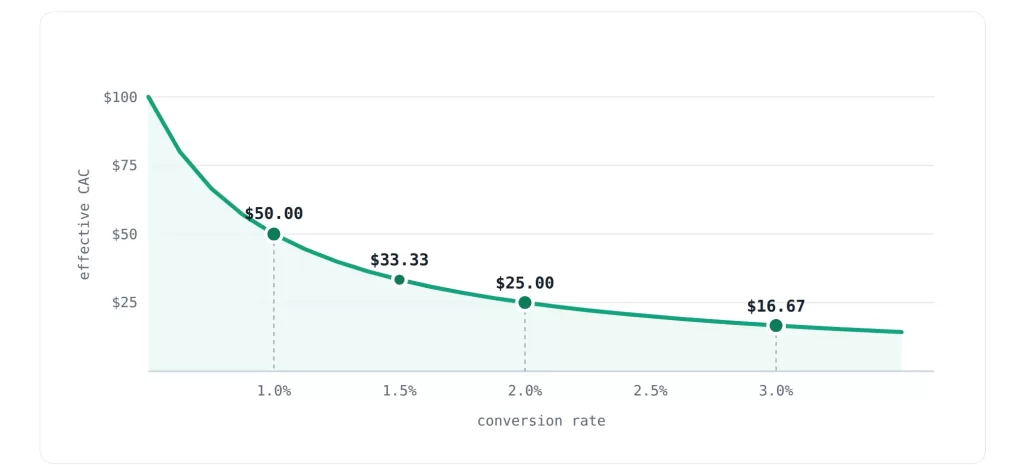
$10,000 spend and 20,000 visitors throughout. From 1% to 3% conversion, CAC drops from $50 to $16.67, a two-thirds reduction on identical spend. Note the shape: the curve is steepest at the left, so the first improvements are worth the most.
This is not a projection or a case study, it is arithmetic. The customers were always in your traffic. A better conversion rate simply stops you paying for the ones who leave.
How much does a small conversion improvement change CAC?
More than people expect, because the relationship is proportional rather than additive. A 50% relative lift in conversion cuts CAC by about a third.
- What each lift is actually worth
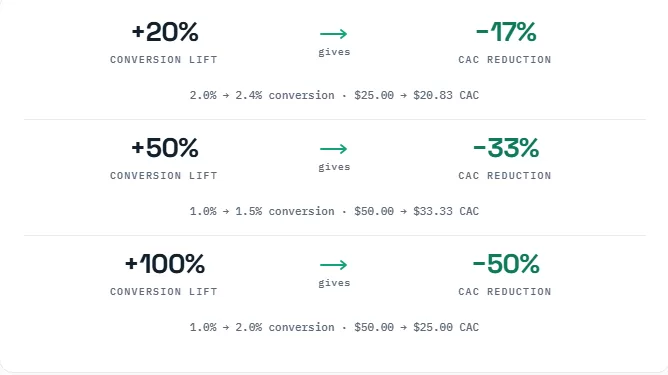
The rule underneath: a lift of L% cuts CAC by L ÷ (100 + L) percent. All figures at $10,000 spend and 20,000 visitors.
Think in relative terms rather than percentage points. And there is usually room: Littledata’s benchmark puts the average Shopify store at 1.4%, with the top 20% above 3.2%, which means four in five stores sit below that mark. Every point of improvement pays out on every future paid visitor.
Does this work across all my channels?
Yes, and it is most valuable on your most expensive ones. A conversion improvement lowers effective CAC on every paid channel at once.
- One fix, every channel
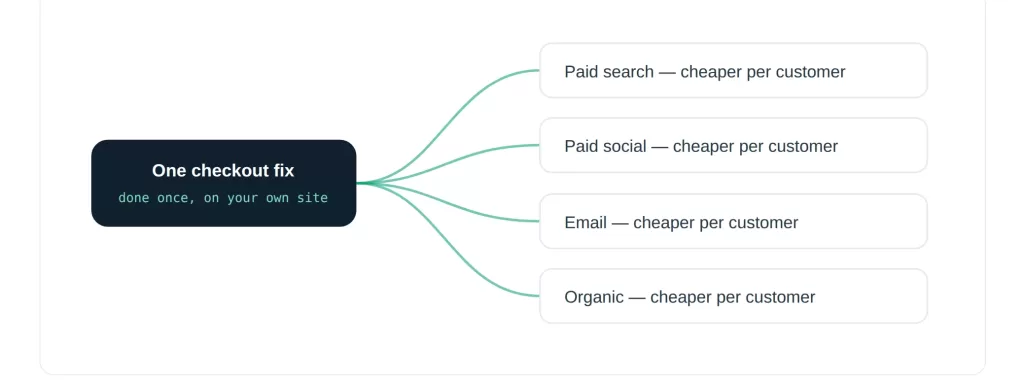
Better ad targeting improves one campaign. A better checkout improves the conversion of all your traffic simultaneously, so the return compounds across the whole media mix rather than one line of it.
Because cold paid social converts lowest of the major channels, around 1.1% against roughly 4.2% for email on 2026 compiled benchmarks, fixing the on-site experience often delivers the biggest CAC reduction exactly where the traffic is coldest and the spend is heaviest. You fix the funnel once; every channel gets cheaper.
Which conversion improvements cut CAC the most?
The ones that recover the most lost customers, which for most stores means mobile checkout, then cost transparency and product pages.
- Why mobile is usually the answer
Mobile
1.2%
Converts about 37% better, on a fraction of the traffic.
Desktop
1.9%
Converts about 37% better, on a fraction of the traffic.
Littledata’s Shopify benchmark, session-based, from its 2023 study of 2,800 sites. Because paid campaigns deliver mostly mobile traffic, the weaker-converting device is the one your ad budget is mostly buying.
After mobile, the biggest recoverable losses are the documented checkout killers: surprise costs at the final step, forced account creation, and long forms. Find your specific worst leak and fix that one first. A diagnostic tells you which is yours rather than guessing from a list.
Is improving conversion better than finding cheaper traffic?
Usually, because you control conversion and you do not control ad prices, and a conversion win compounds while a traffic win erodes.
A cheaper channel is real but temporary: costs rise, audiences saturate, the advantage fades. Improving conversion is a permanent change to your own asset that keeps lowering CAC on every future visitor from every channel. The strongest brands do both, but conversion is the foundation the ad work sits on.
We turn conversion wins into measurable CAC reductions.
We find your funnel’s worst leak, fix it, and measure the lift, then translate that conversion gain into the effective-CAC reduction it produces on your paid channels, proven in your own analytics rather than asserted.
On one engagement, a rebuilt buying path lifted conversion 6% and revenue per visitor 7%, both A/B tested at 95% confidence, which is a direct CAC reduction at constant spend.
Frequently asked questions
If I double my conversion rate, does my CAC really halve?
At constant ad spend, yes. CAC is spend divided by customers, so doubling customers from the same spend halves the cost per customer. The math is exact; the only open variable is how much improvement is achievable on your store.
Does improving conversion rate also increase revenue?
Yes, on both sides. More conversions means more customers and therefore more revenue, and a lower cost to acquire each one. It is one of the few levers that improves the top line and unit economics at the same time.
How is effective CAC different from what my ad platform reports?
Ad platforms report cost per result on their own click, which often overstates return. Effective CAC divides real spend by real customers, which folds in how well your site converts. Two brands with identical ad costs can have very different effective CAC.
What conversion rate should I aim for to lower CAC?
There is no single target, because every improvement lowers CAC proportionally. For context, Littledata puts the average Shopify store at 1.4% and the top 20% above 3.2%, so four in five stores have room to move toward that tier.
How do I calculate the CAC reduction from a given lift?
A conversion lift of L percent cuts CAC by L divided by 100 plus L, expressed as a percentage. A 20% lift cuts CAC by 16.7%, a 50% lift cuts it by 33.3%, and a 100% lift cuts it by 50%. This holds at any spend level.
Keep reading
Sources
Effective CAC = ad spend ÷ customers acquired · worked examples hold spend and visitors constant · self-verifying, cannot go stale
Littledata — Shopify conversion benchmarks.Average 1.4% · top 20% above 3.2% · mobile 1.2% / desktop 1.9% · session-to-order · 2,800 Shopify sites, studied 2023 · littledata.io
midpoints compiled from 2026 ecommerce channel benchmark reporting.Paid social ~1.1% · email ~4.2% · directional ranges, not one measured dataset