Take the store in the worked example above, sitting at 2.0:1 on a contribution basis. Halve its effective CAC from $50 to $25 through better conversion, and the same $100 of lifetime margin now produces a 4.0:1 ratio. Nothing about the customer changed. The pillar guide covers the strategy and the mechanism article shows the arithmetic in full.
CRO / DTC
What Is a Good LTV:CAC Ratio for Ecommerce?
// the number everyone quotes and most calculate wrong

By Fracto Solutions
August 4, 2026
The short answer
For DTC ecommerce, 1.5:1 to 3:1 is the healthy band on 2026 benchmarks, because margins are lower than software. Below 1:1 you are genuinely underwater; sustained above 5:1 usually means you are under-investing in growth. The famous 3:1 rule came from SaaS and sets a bar most healthy DTC brands will fail.
It is the number every investor and founder quotes, and the one most people calculate wrong. Two things go wrong most often: borrowing a threshold from a different business model, and comparing ratios that were built on different definitions of LTV.
This ties directly to how CRO lowers CAC, because CRO improves this ratio from the cost side, which is the faster side to move.
What is a good LTV:CAC ratio?
It depends entirely on your business model. For DTC ecommerce the healthy band is 1.5:1 to 3:1. Subscription and software businesses sit considerably higher, and that is exactly why borrowing their number misleads.
- Healthy bands by business model, 2026
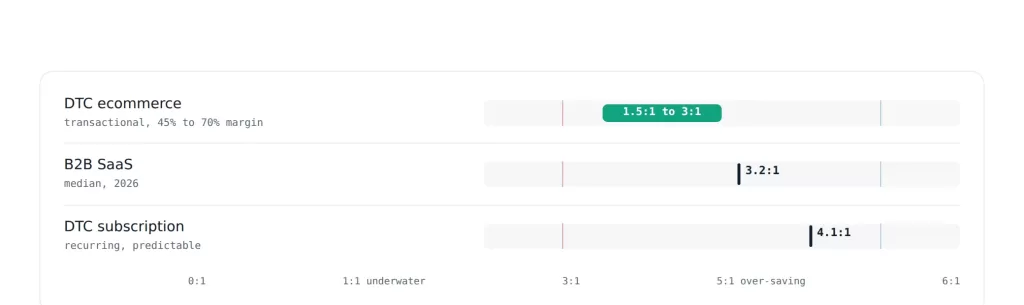
Bands from Foundry CRO’s 2026 LTV:CAC benchmarks. The two faint vertical lines mark the universal limits: below 1:1 each customer costs more than they return, and sustained above 5:1 usually signals under-investment rather than excellence.
LTV:CAC captures both sides of the equation in one figure, which is why it predicts whether paid acquisition is sustainable better than either number alone. A rising CAC is not a problem if lifetime value rises with it. A low CAC is not good news if customers never come back.
Where does the "3:1 rule" come from?
From SaaS, not ecommerce. It was popularised by investor David Skok at Matrix Partners around 2010, based on mature subscription software, and has been applied to everything since.
The two models are structurally different. In SaaS, lifetime value is recurring revenue across a contractually defined multi-year term, at 75% to 90% gross margin, with behaviour that stays predictable well beyond twelve months. In DTC, revenue is transactional and decays, gross margin runs 45% to 70% with real per-order variable cost, and predictive accuracy drops sharply past the first year.
Skok’s original framing also assumed a margin-adjusted LTV, not a simple revenue figure. So when you see “aim for 3:1” quoted without qualification, two separate assumptions have quietly been dropped: the business model and the calculation method.
Why does the ratio vary so much between sources?
Because “LTV” is not one number. The same customer produces very different lifetime value depending on whether you count revenue or contribution margin.
- Same customer, same CAC, two ratios
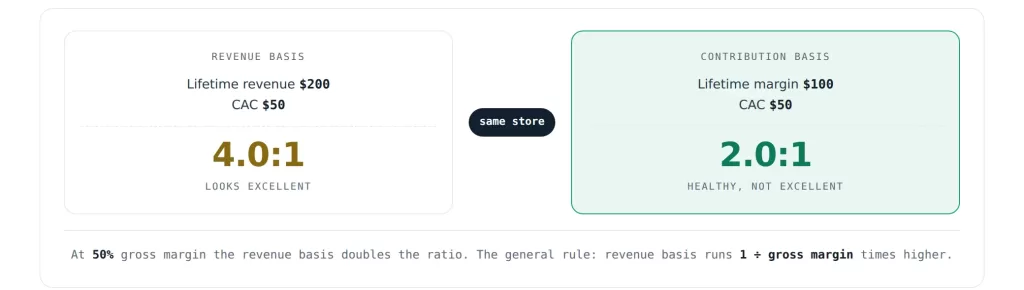
A worked example, not a benchmark. At 70% margin the revenue basis overstates the ratio by about 1.4x; at 45% margin, about 2.2x. This is why two credible sources can quote different “healthy” bands and both be right.
Before comparing your ratio to any published benchmark, check which basis it uses and make sure yours matches. Contribution margin is the version that survives contact with a P&L, and it is the version the bands on this page are meant for.
What is a good ratio for my specific vertical?
It shifts with repeat behaviour and margin. Replenishment categories run higher; high-order-value durables run lower, and both can be perfectly healthy.
Categories with natural repeat purchase, such as supplements, beauty refills and pet food, sustain higher ratios because customers return and lift lifetime value. High-AOV durables like furniture run lower, because the purchase is infrequent and CAC is high relative to a single sale. Subscription models sit at the healthier end for the same structural reason, which is why Foundry puts DTC subscription at 4.1:1 against 1.5:1 to 3:1 for transactional DTC. Compare within your own category and model rather than against a blended figure.
Does CAC payback period matter more than the ratio?
Not more, but you cannot read one without the other. A strong ratio with slow payback can still starve you of cash, and a modest ratio with fast payback can outperform it.
- Ratio against payback speed
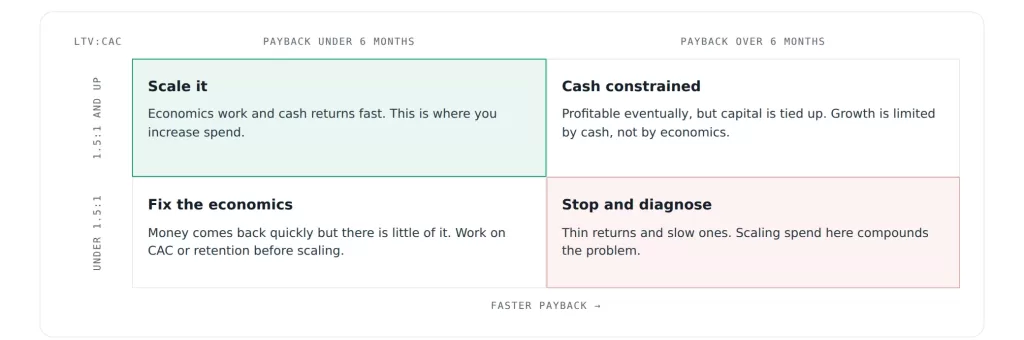
Payback speed compounds: a 2:1 ratio recovered in six months can outperform a 4:1 recovered in eighteen, because the money is back and working sooner. For most DTC categories, payback under about six months is healthy and under 90 days is strong.
How does CRO improve my LTV:CAC ratio?
Directly, from the CAC side. Because the ratio is LTV divided by CAC, lowering CAC raises it without touching lifetime value at all.
You do not have to solve the slow problem of increasing lifetime value to improve your ratio. Lifting LTV takes quarters of retention work. Improving conversion lowers the effective CAC on your paid traffic within a single test cycle, and the ratio moves immediately.
How Fracto helps with this
We improve the ratio from the side you control: CAC.
Lifting lifetime value is slow. Lowering CAC through better conversion is fast and fully within your control, and because the ratio is LTV over CAC, cutting CAC raises it immediately. We find the funnel leak, fix it, and show the ratio move in your own numbers rather than in a projection.
On one engagement, a rebuilt buying path lifted conversion 6% and revenue per visitor 7%, both A/B tested at 95% confidence.
// we would rather show up in your reporting than in your inbox
Frequently asked questions
Is 3:1 a good LTV:CAC ratio for ecommerce?
It sits at the top of the healthy DTC band rather than in the middle of it. On 2026 benchmarks, DTC ecommerce runs 1.5:1 to 3:1 because margins are lower than software. The 3:1 rule came from SaaS, where margins are 75% to 90%, so treating it as a floor sets a bar most healthy DTC brands will fail.
What does an LTV:CAC below 2:1 mean?
Not that you are underwater, which is a common misreading. At 2:1 each customer returns twice what they cost to acquire, which is inside the healthy DTC band. Genuine underwater is below 1:1, where acquisition costs more than the customer ever returns. Between 1:1 and 1.5:1 the economics work but leave no room for overhead or error.
Can an LTV:CAC ratio be too high?
Yes. Sustained above roughly 5:1 usually signals under-investment in growth rather than excellence: you could profitably spend more to acquire customers and are not doing so, which leaves capital idle while competitors buy the market.
Should I use revenue or contribution margin to calculate LTV?
Contribution margin, for any real decision. Revenue-based LTV ignores COGS, shipping and returns, so it runs higher by roughly one divided by your gross margin: about 1.4x at 70% margin and about 2.2x at 45%. Mixing bases is the most common reason two people argue about the same ratio.
Does payback period matter more than the ratio?
Neither replaces the other. The ratio tells you whether the economics work eventually; payback tells you how fast the cash returns. A 2:1 ratio recovered in six months can outperform a 4:1 recovered in eighteen, because faster reinvestment cycles compound. Read them together.
Keep reading
Sources
DTC ecommerce 1.5:1 to 3:1 · DTC subscription 4.1:1 · B2B SaaS 3.2:1 median · below 1:1 underwater · sustained 5:1+ signals under-investment · 3:1 rule traced to David Skok, Matrix Partners, c.2010
SaaS gross margin 75% to 90% and contractual lifetime · DTC gross margin 45% to 70%, transactional, predictive accuracy drops past 12 months
Revenue basis runs 1 ÷ gross margin times higher · worked example uses $200 lifetime revenue, 50% margin, $50 CAC · self-verifying