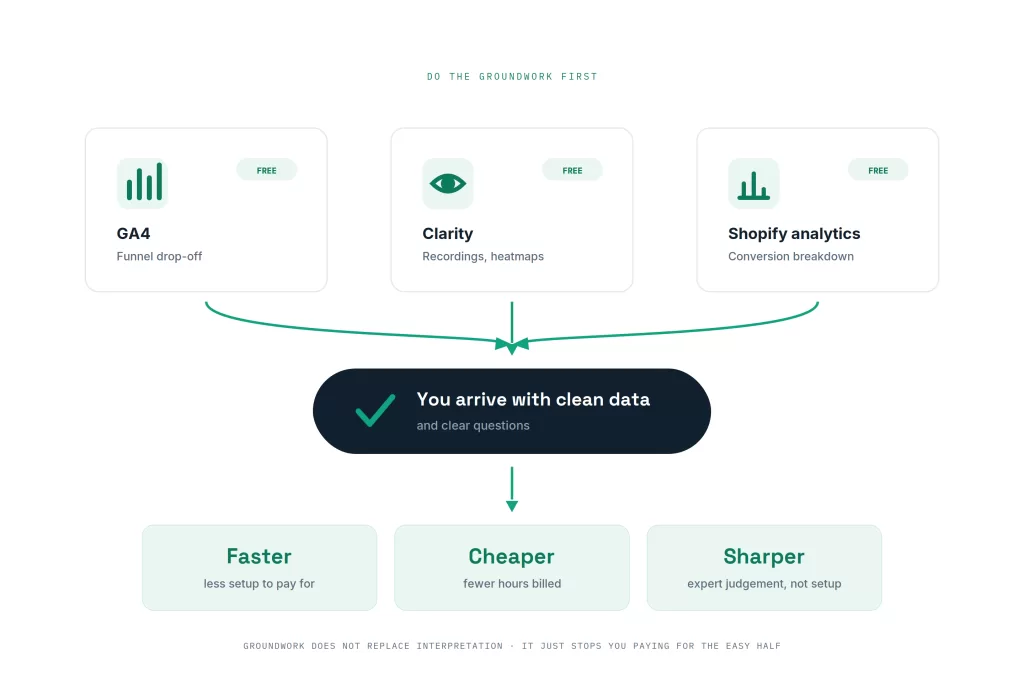
You can cover a surprising amount with free tools. GA4 shows your funnel drop-off. Microsoft Clarity gives you session recordings and behaviour signals at no cost. Shopify’s own analytics shows your conversion breakdown. Doing this groundwork won’t replace an expert’s ability to interpret and prioritize, but it means you arrive with clean data and clear questions, which makes any paid audit faster, cheaper, and sharper. There’s a full walkthrough in how to diagnose Shopify conversion issues.
CRO / Ecommerce
How Much Does an Ecommerce CRO Audit Cost?
// what you pay for, and what moves the number

By Fracto Solutions
July 31, 2026
The short answer
A one-time ecommerce CRO audit typically costs $2,000 to $15,000, depending on your site’s complexity, traffic, and how deep the analysis goes. Hourly advisory runs $150 to $500. The price should be judged against what fixing the findings is worth, not on the sticker figure alone.
Cost is usually the deciding question, so it’s worth understanding what you’re actually paying for and what moves the number. For the full picture of what an audit includes, see what a CRO audit includes. This piece is about the money.
How much does a CRO audit cost in 2026?
A one-time ecommerce CRO audit generally runs $2,000 to $15,000. Published 2026 agency pricing clusters consistently in that band.
- CRO audit pricing, 2026 market
Type
Typical cost
Best for
One-time ecommerce CRO audit
$2,000 to $15,000
A full diagnosis + ranked roadmap
Hourly advisory / consulting
$150 to $500/hr
Single questions or light review
Lighter heuristic review
lower end
A best-practice sanity check
Source: 2026 CRO agency pricing guides (ConversionTeam, ClicksGeek, Convertibles, and others), compiled July 2026. Exact price scales with traffic, site complexity, and depth of analysis.
Simpler stores, clean data, modest catalog, standard Shopify, sit at the lower end. Large, high-traffic, or custom-built sites sit higher, because there’s more to analyze and more revenue riding on the outcome. Beyond one-time audits, some consultants bill hourly, commonly $150 to $500 per hour.
It’s worth separating the audit from ongoing CRO here, because the two get confused. The audit is a one-time diagnosis. Ongoing optimization, running tests month after month, is a separate retainer and a different budget entirely.
What determines the price of a CRO audit?
Four things mainly: your revenue and traffic, your site’s complexity, your catalog size, and how deep the audit goes.
- Revenue and traffic. Agencies scale pricing to the revenue impact of the work. A high-traffic store has more to gain from small lifts, so its audit tends to cost more.
- Site complexity. A standard Shopify store is quicker to audit than a headless or heavily customized build.
- Catalog size. More products and categories mean more templates, paths, and pages to review.
- Depth of analysis. A quick heuristic review is cheaper than a full data-backed audit with session analysis and a sequenced roadmap.
The last one matters most, because it’s where “audit” means wildly different things. Two quotes at the same price can deliver very different depth, so read what’s actually included rather than comparing headline numbers.
Why do CRO audit prices vary so much?
Because “audit” isn’t a standardized product. It ranges from a one-page checklist to a multi-week data investigation, and the word covers both.
At the low end, some “audits” are essentially a reviewer’s opinion measured against generic best practices, useful as a sanity check, but not grounded in your data. At the high end, a professional audit validates your tracking, reads your actual funnel, watches real sessions, and produces a ranked, evidence-backed roadmap. Both get called an audit, which is exactly why prices span such a wide range.
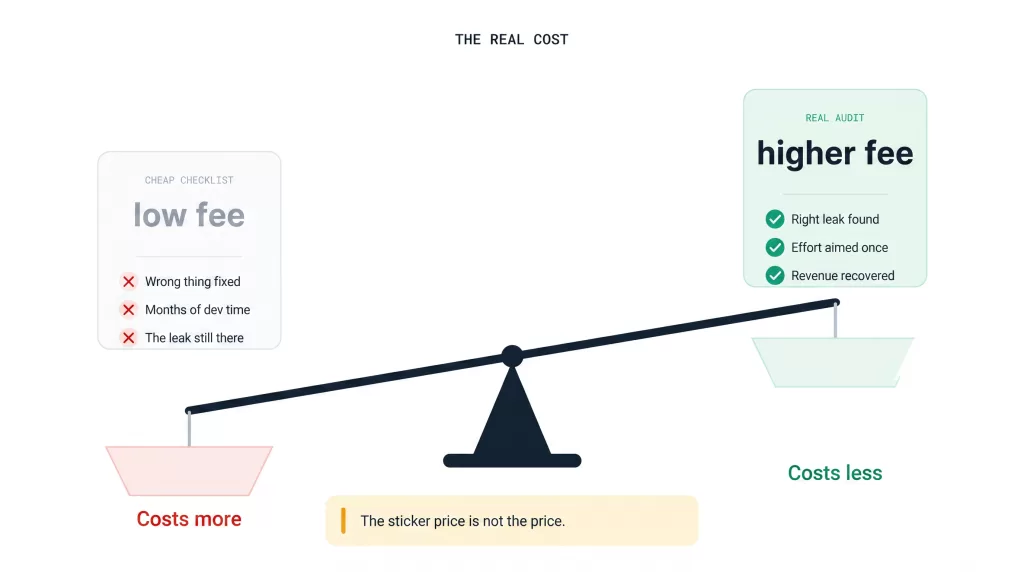
So when comparing quotes, the real question isn’t “which is cheaper” but “which is actually diagnosing my store versus describing it.” A cheap checklist that sends you fixing the wrong thing costs more in wasted time than a thorough audit that points you at the real leak.
Is a CRO audit worth the cost?
Worth it when you have enough traffic to diagnose and you’ll act on the findings. Under those conditions, the return usually dwarfs the fee.
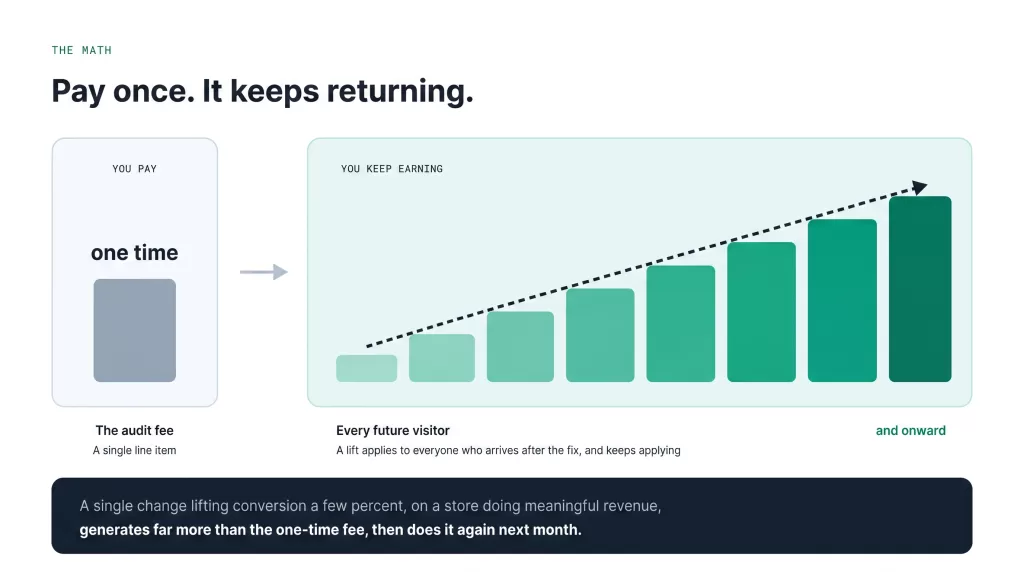
The math is simple. A single change that lifts conversion even a few percent, on a store doing meaningful monthly revenue, generates far more than the one-time audit cost, and keeps generating it for every future visitor. That’s the leverage: you pay once to redirect effort you’re already spending toward the changes most likely to work.
Two caveats keep it honest. If your traffic is too low for the data to mean anything, spend on traffic first. And if the findings will sit unread, the audit returns nothing, the value is entirely in implementation.
How can I get a CRO audit for less?
Do the free diagnostic groundwork yourself first, so you’re paying an expert for judgement, not for setup.
How Fracto helps with this
We diagnose first, so you never pay to fix the wrong thing.
Our audit is baseline-first: we validate your tracking, read your funnel, watch real sessions, and hand you a ranked plan tied to your own numbers, priced against what fixing each leak is actually worth.
// we would rather show up in your reporting than in your inbox
Frequently asked questions
Is a CRO audit a one-time cost or ongoing?
A one-time cost. The audit is a diagnosis you pay for once. Ongoing CRO, continuous testing and implementation, is a separate retainer billed monthly.
What's the cheapest a legitimate CRO audit can be?
Entry-level audits start around $2,000, though very light heuristic reviews can be less. Below that you’re usually getting a generic checklist rather than a data-backed diagnosis of your own store.
Does a more expensive audit mean a better one?
Not automatically. Price tracks scope, traffic, and complexity, not just quality. Judge an audit by whether it’s grounded in your actual data and produces a ranked, evidence-backed plan.
How do I know if an audit is worth paying for?
Weigh the cost against what fixing the findings is worth. If a plausible conversion lift on your revenue would cover the fee many times over, and you’ll act on the plan, it’s worth it.
How much does a professional CRO audit cost?
A professional CRO audit, run by an experienced reviewer rather than an automated tool, sits in the $2,000 to $15,000 one-time range, or $150 to $500 per hour for advisory work. The lower end covers simpler stores with clean data. What you are paying for is judgement: validated tracking, session analysis, and a ranked roadmap rather than a generic best-practice checklist.
Keep reading
Sources
CRO audit pricing compiled from 2026 agency pricing guides: one-time ecommerce audits commonly $2,000 to $15,000; hourly advisory $150 to $500 (ConversionTeam, ClicksGeek, Convertibles, and others, 2026).